Commercial Fleet Winter Prep: Paint Cleanup, Undercoating, and Corrosion Protection
There’s a short window every fall where fleets can still get ahead of winter, and it closes faster than most people expect. Once the first storm hits and the brine trucks are out, every bare edge, stone chip, and scraped panel on your equipment becomes an open door for corrosion. And unlike a dent, corrosion doesn’t wait for a convenient time to show up. It works quietly through the winter and turns into a structural problem, a failed inspection, or a repaint you didn’t budget for.
Commercial fleet winter prep isn’t glamorous work. But for operators running box trucks, school buses, transit vehicles, and trailers through a New England winter — Connecticut, Massachusetts, Rhode Island, New Hampshire, and everywhere in between — it’s some of the highest-return maintenance on the calendar.
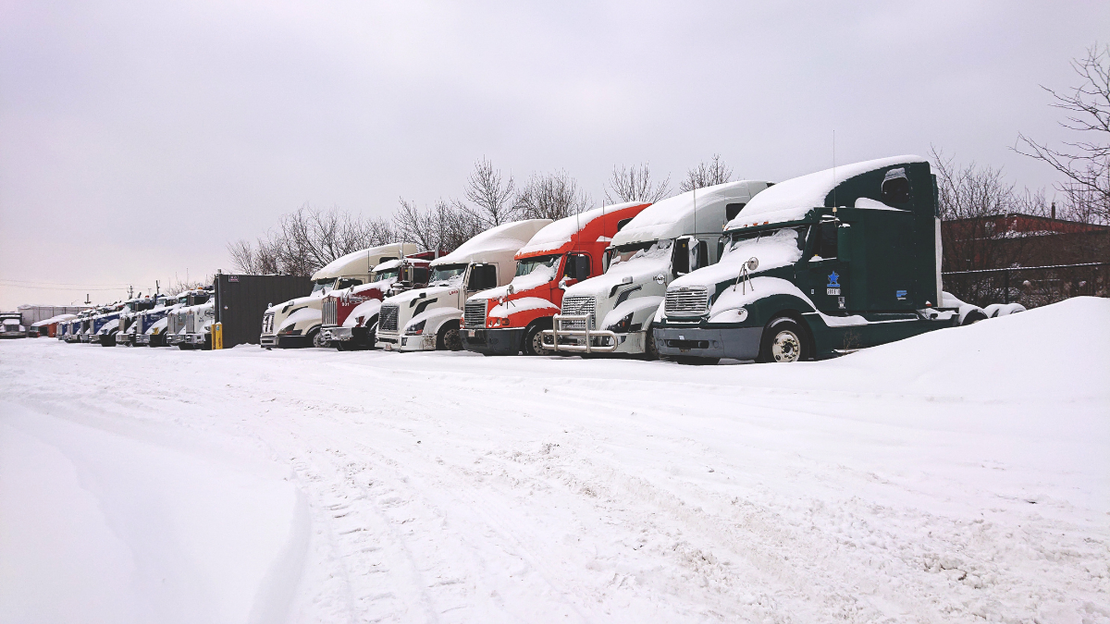
What Actually Happens to Your Fleet Between November and March
Most people picture rock salt scattered across a highway. That’s not really what’s happening anymore.
The Connecticut Department of Transportation now uses a 23% sodium chloride brine solution that gets applied to road surfaces up to three days before a storm even arrives, along with chloride-based products including sodium, magnesium, and calcium chlorides. The reason is straightforward: plain rock salt stops working around 15–20°F, while magnesium chloride stays effective down to about 5°F and calcium chloride down to roughly -10°F. For a state that needs roads clear at single-digit temperatures, chlorides are the only cost-effective answer.
They’re also relentless on metal. These compounds are hygroscopic, meaning they pull moisture out of the air. A truck that’s been parked in a dry yard for three days is still sitting with an active, corrosive solution on its frame rails, crossmembers, and lower panels. The road dried out. Your undercarriage didn’t.
It’s the Same Playbook Across New England
If your routes cross state lines, nothing changes at the border. Every state in the region has moved to the same pre-treat-and-pre-wet strategy over the past fifteen years.
- Massachusetts has been pre-treating with liquid brine since 2011, applying roughly 20 to 50 gallons of liquid deicer per lane-mile, and uses somewhere in the neighborhood of half a million tons of salt in a typical winter. MassDOT’s own reporting from the 2025–26 season logged over a million gallons of magnesium chloride used just for pre-wetting salt.
- Rhode Island has been applying a 23.3% brine solution ahead of forecasted storms since 2012.
- New Hampshire was the first state in the country to salt its roads back in 1941, and applies on the order of 400,000 tons a year across state highways, town roads, and private lots.
And state highway departments are only part of the picture. Municipalities maintain far more lane miles than any state DOT, and many use pre-treated salt blends of their own. If your drivers spend any time on local roads, in a school lot, or in a distribution yard that gets salted by a contractor, they’re picking up chloride exposure nobody’s tracking.
The cost adds up. AAA’s Automotive Engineering research put corrosion damage from de-icing chemicals at roughly $3 billion annually in the U.S., or about $15.4 billion over a five-year span, with the average individual repair landing near $490. That figure is based on passenger vehicles. Scale it to a 40-foot bus, a box truck with a steel-framed body, or a trailer with aluminum panels riveted to a steel frame, and the per-unit math looks very different.
Step One: Paint Cleanup Before the Salt Arrives
Paint isn’t cosmetic on a commercial vehicle. It’s the primary corrosion barrier, and every place it’s been compromised is a place where winter gets underneath.
Go through the fleet and look for:
- Stone chips and gravel rash along lower panels, rockers, and behind wheel wells
- Scrapes from dock contact, mirrors, and tight yards that went down to primer or bare metal
- Failing edges on doors, wheel arches, and panel seams where paint has started lifting
- Unrepaired minor collision damage from earlier in the year, where a crease has cracked the finish
Anything exposing bare metal needs to be addressed before the first brine application, not after. A chip that would take an hour of touch-up work in October can be a perforated panel by April. That’s the whole equation.
This is also the moment to deal with damage you’ve been deferring. If a unit has body work sitting on the “we’ll get to it” list, winter is the season that decides whether it stays a body repair or becomes a structural one. Our paint work and body work teams handle commercial refinishing in a downdraft booth sized for full buses and trailers, which means a repaint or panel repair doesn’t require cutting your vehicle down to fit somebody’s passenger-car booth.
Step Two: Undercoating and Corrosion Protection
Undercoating is the piece most fleets skip, and it’s the piece that pays back the most on equipment you plan to keep for ten or fifteen years.
The undercarriage takes the worst of it because that’s where brine spray lands, collects, and stays. Key areas worth protecting:
- Frame rails and crossmembers — structural, expensive, and hard to inspect once corrosion is advanced
- Wheel wells and fender liners — constant direct spray
- Body mounts and suspension attachment points — where corrosion becomes a safety issue rather than a cosmetic one
- Seams, welds, and drilled holes — anywhere two pieces of metal meet and water can wick in and sit
- Battery boxes, step wells, and lower compartment doors — high-moisture areas on buses in particular
A few things worth knowing before you book it. Undercoating works best on a clean, dry substrate, which means fall is the right time — applying it over existing salt residue or active corrosion seals the problem in instead of preventing it. Different products suit different needs; a wax-based or rubberized coating protects differently than a penetrating oil, and the right choice depends on whether you’re protecting a new unit or slowing down corrosion on an older one. And undercoating doesn’t repair damage. If there’s already scale or perforation, that gets addressed first.
Step Three: Know Where Your Vehicle Type Fails
Corrosion isn’t uniform. It shows up in predictable places depending on what you run.
School buses take it hardest around step wells, wheel wells, body-to-chassis mounting points, and the lower skirt panels that catch spray off the front tires. Districts and contractors running full routes on treated roads all winter see this accelerate fast. If you got repairs done during the summer window — and summer is genuinely the best time for school bus body work — protecting that work now is what makes it last.
Box trucks and delivery vans show it at the rear frame and the underside of the body floor, plus roll-up door tracks and rear sill areas where salt gets tracked in and sits through the weekend.
Trailers are their own problem. Dissimilar metals — aluminum panels on steel frames — set up galvanic corrosion that chloride exposure accelerates significantly. Combine that with the everyday impact damage trailers already accumulate in tight yards, and winter turns common trailer damage like DID panel and corner cap issues into something worse.
Heavy-duty and work trucks suffer at frame rails, air line routing points, and anywhere hardware passes through a painted surface.
The Compliance Angle Nobody Budgets For
Here’s the argument that usually gets winter prep approved: corrosion is a DOT problem, not just a body shop problem.
Brake-related violations are consistently the largest category of out-of-service violations in roadside inspections. In CVSA’s 2025 International Roadcheck data, brake system violations accounted for 24.4% of all vehicle out-of-service findings, and combined with 20%-defective-brakes violations they made up over 41% of the total. Under the North American Standard Out-of-Service Criteria, hoses and lines that are cracked, chafed, or damaged through the outer cover are an out-of-service condition. Corroded air lines, seized fittings, and corroded rotors all live in that territory — and CVSA’s own 2026 Brake Safety Day data flagged corroded air disc rotors as one of the most common single defects found.
None of those failures happen overnight. They’re the result of three or four winters of chloride exposure on components nobody protected. A vehicle placed out of service at a scale house costs you the repair, the tow, the downtime, and a mark on your safety profile. Winter prep is cheap by comparison.
Why This Is an October Job, Not a January One
Two reasons.
The first is practical. Prep work has to happen before exposure, not in the middle of it. Paint and coating both need clean, dry, temperature-controlled conditions to cure properly. That’s a shop job in the fall, not a parking lot job in February.
The second is scheduling. Once winter starts, our bays fill with collision work — because winter fleet accidents don’t wait for an opening. If your unit is in line behind six storm-damage repairs, “we’ll handle it in January” becomes March. Booking prep now means you’re choosing your own downtime instead of having weather choose it for you.
Get Your Fleet Ready at DeVivo Collision
DeVivo Collision Centers works on commercial and heavy-duty vehicles specifically — buses, box trucks, trailers, transit vehicles, and work trucks — and we serve fleets across New England from three locations:
- Middletown, CT — central Connecticut, including Hartford and New Haven, plus western Rhode Island. Home to one of the largest downdraft spray booths in the state, sized so a full bus or trailer can be refinished without disassembly.
- Randolph, MA — greater Boston and southeastern Massachusetts, including Brockton and Quincy, plus New Hampshire and Rhode Island.
- Seekonk, MA — DeVivo Fleet Services, at 80 Leavitt St, right on the Rhode Island line and well positioned for operators running in and out of Providence and the surrounding corridor. This location handles general fleet service rather than major collision work. Reach them at (508) 521-6032.
Prep Isn’t Only Body and Paint
Winter exposure doesn’t stop at the sheet metal. The same chlorides working on your panels are working on air lines, fittings, electrical connections, battery terminals, and brake components — and those are the failures that put a unit out of service at a scale house rather than just making it look rough.
That’s the practical reason to treat winter prep as one pass instead of two. A unit that comes in for paint cleanup and corrosion work is a unit that’s already stopped, already on a lift, and already being looked at closely. Pairing that with scheduled preventive maintenance and a diagnostic check on the systems most exposed to salt means you spend one block of downtime instead of two, and you find the corroded fitting in October instead of on the side of I-95 in February.
Between our collision facilities and DeVivo Fleet Services in Seekonk, we can cover both halves of that — including mobile service at your location for fleets that can’t spare the units to send them out.
Whether you’re running fifty units or five, we can look at your fleet, tell you what actually needs attention before the first storm, and give you a real timeline instead of a generic estimate.
If you’ve got vehicles carrying unrepaired damage, failing paint, or corrosion you’ve been watching get worse, the window to deal with it is now.
Request a quote or call us directly — Middletown, CT at (860) 613-2868, Randolph, MA at (781) 986-8305, or DeVivo Fleet Services in Seekonk, MA at (508) 521-6032.