Category:

Repair Tips & Best Practices

Garbage Truck Body Repair: What Northeast Waste Management Companies Need to Know

Downtime Hurts the Bottom Line

For waste management companies across Connecticut, Massachusetts, and Rhode Island, time truly is money. Each day a garbage truck is off the road can cost $448 – $760 in lost productivity per vehicle. For fleets operating under tight municipal contracts and strict route schedules, even a single truck out of service can create a domino effect of missed pickups, customer complaints, and costly overtime for other drivers.

And here in New England, where routes wind through narrow streets, tight cul-de-sacs, and densely packed suburban neighborhoods, the risk of body damage is even higher.

That’s why having a trusted regional collision repair partner who understands refuse vehicles and can turn repairs quickly is essential to keeping your operation efficient and compliant.
Garbage truck driver picking up trash on a sunny day.

The Unique Challenges of Refuse Vehicle Collisions

Why Garbage Trucks are Collision Prone

Refuse vehicles operate in some of the toughest conditions in the commercial fleet world. A typical collection truck may make 500-1,000 stops per day, reverse into driveways or alleys, and maneuver through tight streets, often before sunrise. Add reduced visibility, driver fatigue, and frequent backing, and accidents become almost inevitable. 

Common risk factors include:

  • Frequent stopping and reversing in residential zones
  • Limited rear visibility due to large bodies and mirrors
  • Operation in confined urban and suburban routes
  • Repetitive motion and driver fatigue over long shifts

Common Types of Body Damage

It doesn’t take much to take a garbage truck out of commission. Refuse fleets regularly face:

  • Side panel dents from backing into posts or trees
  • Front-end damage from abrupt stops or low-speed collisions
  • Read-end impacts from following vehicles
  • Hydraulic housing damage during lift operations
  • Mirror and lighting breaks from tight clearances 
  • Paint and cosmetic wear from daily debris and branch scrapes

Unlike standard commercial trucks, refuse vehicles present unique repair challenges due to their specialized hydraulic systems, heavy-duty frames, and integration of collection mechanisms with the vehicle body.

The True Cost of Delayed Repairs

When one of your trucks is down, the expenses add up fast, often beyond the initial body repair estimate. 
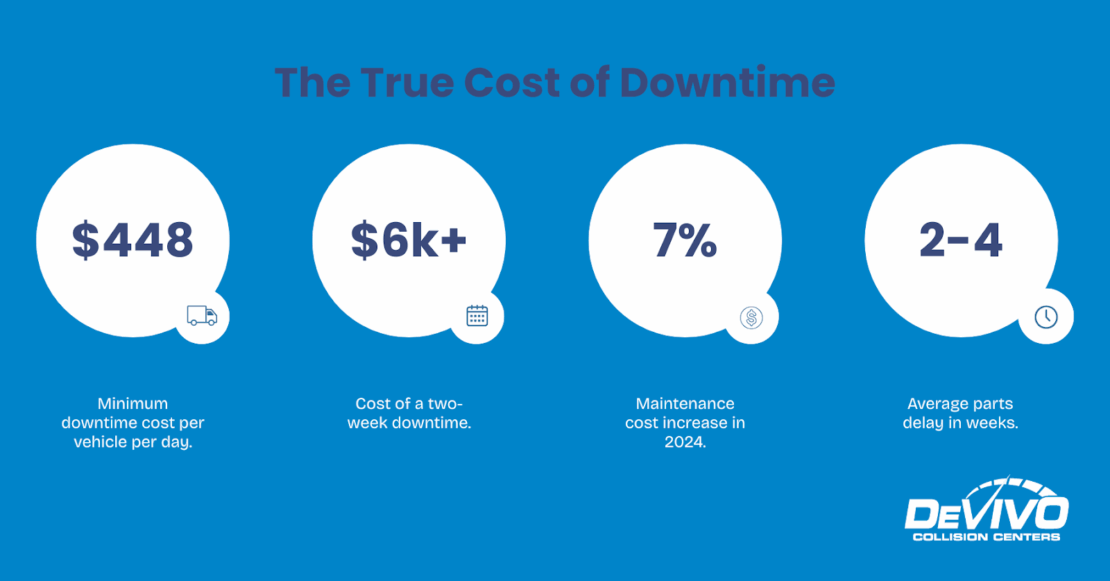
Fleet downtime infographic showing daily and weekly costs of refuse truck repairs.

Direct Costs

  • Maintenance costs rose 7% in early 2024.
  • Tire prices increased 8.5% year-over-year, while parts delays continue to slow repair times.
  • Route disruption often requires driver overtime or additional trucks to fill in.

Indirect Costs

  • Municipal contract penalties for missed pickups.
  • Customer service complaints and loss of goodwill
  • Driver morale issues from overextended workloads
  • Safety risks if damaged trucks remain in service
  • Reduced resale value during fleet rotation

At an average downtime cost of $448 – $760 per day, a two-week delay could set a fleet back $6,272 – $10,640 per vehicle. For multi-truck operations, those losses compound quickly.

Regional Operating Challenges in Connecticut and Massachusetts

Weather & Environmental Factors

New England weather isn’t kind to metal. 

  • Winter salt accelerates corrosion on exposed panels.
  • Freeze-thaw cycles worsen existing dents and cracks.
  • Rain and road grime degrade paint and seals over time.

High-quality paint, proper undercoating, and corrosion-resistant materials are critical for any long-term body repair. 

Local Operating Conditions

Refuse fleets in Connecticut and Massachusetts face additional regional challenges: 

  • Historic neighborhoods with narrow, winding roads
  • Dense suburban communities (Hartford County, Greater Boston) with limited maneuvering room
  • Frequent interaction with school buses and morning traffic
  • Seasonal leaf and yard waste pickups adding route strain
  • Urban congestion around Boston, Hartford, and New Haven

What Fleet Managers Should Look for in a Body Shop

Not every collision center is equipped to handle a refuse vehicle. When choosing a repair partner, look for these key qualities:

Specialized Expertise

  • Experience repairing rear-, front-, and side-loader refuse trucks 
  • Knowledge of hydraulic systems and frame structures
  • Familiarity with Mack, Peterbilt, Freightliner, and Autocar chassis

Efficiency & Turnaround Time

  • In-house frame straightening and paint capabilities
  • Strong parts sourcing relationships to avoid long delays
  • Insurance coordination support

Quality That Lasts 

  • Use of OEM-certified parts where possible
  • Paint-matching and rust prevention procedures
  • Documentation for fleet compliance and resale records

Geographic Convenience

Two locations reduce downtime and transport costs:

  • Middletown, CT: Serving Hartford, New Haven, and all of Connecticut and Rhode Island
  • Randolph, MA: Serving Greater Boston, the South Shore and all of Massachusetts and Rhode Island

Both our Middletown, CT, and Randolph, MA locations offer pickup and delivery services for fleet vehicles, reducing transport time and keeping your trucks on route.

Preventive Strategies to Reduce Future Damage

Even the best repairs can’t eliminate every risk, but proactive management can reduce frequency and severity.

Driver Training

  • Backing procedures and spotter communication
  • Mirror and blind spot awareness
  • Smarter route planning to avoid tight turns
  • Refresher courses in defensive driving

Technology Solutions

  • Backup and side-view cameras
  • Sensor-based proximity alerts
  • Route optimization software
  • Telematics for tracking driver behavior and braking patterns

Fleet Maintenance Integration

  • Include body inspections in preventive maintenance (PM) cycles
  • Address minor scratches or dents early to prevent corrosion
  • Apply protective coatings during offseason
  • Regularly check mirrors, lights and hydraulics

Why Choose a Regional Specialist with Multiple Locations

DeVivo Collision Centers understands the demands of municipal and private waste haulers across New England. With two purpose-built heavy vehicle facilities, our team provides expert collision repair designed to keep fleets moving. 

Benefits of Regional Expertise

  • Deep understanding of Connecticut and Massachusetts operating environments 
  • Faster turnaround thanks to local supplier networks
  • No long-distance transport or parts shipping delays

Our Facilities

  • Middletown, CT: Centrally located for Stamford, Hartford, and Danbury fleets
  • Randolph, MA: Convenient to Greater Boston, Brockton, and Westborough

What Sets Us Apart

  • Commercial-grade paint booths for full-size refuse trucks
  • Heavy-duty frame straightening equipment
  • Technicians trained in refuse vehicle repair
  • Insurance relationships for smoother claim handling

Get Your Fleet Back on Route Faster

When one of your trucks goes down, you don’t have time to wait. Contact DeVivo Collision Centers today.

By 0 Comments

How to Choose the Right Collision Center for Commercial Vehicles

When full-size trucks, buses, and fleets arrive at DeVivo Collision, whether at our Middletown, CT or Randolph, MA location, they’re not treated like standard passenger vehicles. Our facilities are designed from the ground up to handle the size, complexity, and urgency of commercial vehicle collision repair. But what exactly makes a collision center “commercial-grade?”

Built for Bigger, Tougher Jobs

Most body shops are set up for consumer vehicles like sedans and SUVs. Commercial vehicles like box trucks, buses, and fleet vans require specialized tools, larger workspaces, and higher weight capacities.

At DeVivo Collision, our facilities are equipped with:

  • Oversized spray booths that can accommodate long vehicles without disassembly
  • Heavy-duty frame straightening machines capable of restoring truck chassis
  • Advanced paint systems designed for durability and high-volume commercial use
  • Dedicated bays for large equipment, minimizing turnaround time

These upgrades are for safety, precision, and long-term reliability.

The High Stakes: Collision Frequency in Commercial Fleets

Collisions aren’t just an occasional risk. They’re a routine challenge for fleet operators.

Each damaged heavy-duty vehicle leads to downtime, missed routes, and lost revenue, making access to a capable, fast-turnaround collision center essential to business continuity.

What Defines a Commercial‑Grade Collision Center?

Not every shop is equipped, or qualified, to handle the demands of large commercial vehicles. A true commercial collision center should offer the following:

FeatureBenefit for Commercial Clients
Oversized spray booths & baysHandles long-length trucks, buses, and trailers without disassembly
Heavy-duty frame & structural equipmentStraightens chassis and aligns commercial vehicle frames accurately
Commercial-grade paint-curing systemsDurable finishes with OEM-grade coatings to sustain high wear
Certified techniciansTechnicians certified to I‑CAR Gold or OEM standards ensure precision and safety
Comprehensive mechanical and structural servicesIncludes welding, diagnostics, and wheel alignment beyond cosmetic fixes
Insurance-friendly workflow & OEM partsEnsures smoother claims and factory-level quality restoration

These capabilities align with best practices shared by top certified collision centers nationwide and they’re built into the day-to-day operation at DeVivo.

Certified Technicians Who Know Commercial

Working on a 40-foot bus or a refrigerated delivery truck isn’t the same as repairing a compact car. It requires advanced training, technical expertise, and a deep understanding of commercial vehicle systems.

That’s why our team includes I-CAR certified and OEM-trained technicians. We regularly work on:

  • School and shuttle buses
  • Box trucks and step vans
  • Utility and service vehicles
  • Tractor trailers and fleet trucks

Whether it’s collision repair, structural work, or paint restoration, we restore vehicles to professional, road-ready condition.

Fast Turnaround, Minimal Downtime

We understand how costly it is to have a vehicle out of service. A delivery truck sitting in a parking lot is lost revenue. A school bus off the road means missed routes.

Our team prioritizes fast, efficient repairs without cutting corners. We coordinate directly with insurers, use OEM-grade parts when needed, and offer clear timelines so you can get your vehicle back on the road where it belongs.

Real Facilities for Real Commercial Work

Not every shop that claims to do “fleet repair” is truly equipped for it. DeVivo Collision is one of the few collision centers in New England with a large downdraft spray booth, designed specifically for commercial vehicles. It’s one of the largest in the state of Connecticut, allowing us to paint full buses and trailers with factory-level finish and precision.

Two Locations, Same High Standards

We proudly serve commercial customers across New England from our shops in:

  • Middletown, CT: Conveniently located for fleets operating in central CT, including Hartford, New Haven, and surrounding areas.
  • Randolph, MA: Serving greater Boston and southeastern Massachusetts, including Brockton, Quincy, and beyond.

Whether you’re managing a fleet of 50 or operating a single heavy-duty work truck, we’re ready to help.

Let’s Get You Back on the Road

At DeVivo Collision, commercial-grade isn’t a buzzword, it’s how we operate. We know the urgency, the standards, and the stakes. From structural repairs to paint perfection, we’ve got your vehicle covered.

If your truck, bus, or fleet vehicle needs professional attention, contact us today. We’ll get you back in business, fast.

By 0 Comments

Why Experience Matters in Collision Repair

Choosing a collision repair provider often comes down to one thing: experience. Whether it’s a fleet truck or emergency vehicle, knowing your shop has seasoned professionals can make the difference between safe, reliable restoration, or disappointment.

Why Collision Repair Experience Isn’t Optional

Modern vehicles, especially commercial and heavy-duty ones, are more complex than ever. They feature advanced driver assistance systems (ADAS), specialty materials like high-strength steel or aluminum, and strict OEM repair standards. Inexperienced shops might overlook subtle damage or misdiagnose repairs, which can cost time, money, and even compromise safety.

Experienced technicians not only understand how to repair physical damage, but know how to:

  • Accurately assess hidden frame or structural issues
  • Safely repair or replace advanced materials without weakening them
  • Work with OEMs and insurance companies to follow proper repair protocols
  • Reduce downtime through efficient, knowledgeable workflow

According to CCC Intelligent Solutions, commercial vehicle repairs involving ADAS-equipped vehicles have increased in complexity and cost, year over year, particularly due to specialized parts and recalibration needs.

Downtime = Lost Revenue

For businesses, every day a vehicle is out of commission can mean lost income. A report from FleetMaintenance revealed that unscheduled downtime costs fleets an average of $448 to $760 per day per vehicle, depending on vehicle type and region.

Experienced repair shops know how to navigate this pressure. They’ve seen a wide range of damage scenarios, have protocols in place for fast parts sourcing, and can prioritize workflow to minimize disruption.

Real Results Come from Real Experience

Not all body shops are equipped to handle commercial or heavy-duty vehicles, and not all technicians are trained equally. What sets an experienced commercial collision center apart is the ability to offer comprehensive, high-standard services under one roof. That means technicians who are certified to ICAR Gold or OEM standards, ensuring your vehicle is repaired to meet, or exceed, manufacturer standards.

It also means the facility has the tools and knowledge to repair more than just dents and paint. In-house frame straightening and alignment help restore the structural integrity of your vehicle after a major impact, while understanding of ADAS calibration and diagnostics ensures your safety systems work exactly as they should once repairs are complete.

Finally, a truly experienced shop knows how to navigate commercial insurance and claims processes smoothly. That kind of support reduces headaches for business owners and gets vehicles back on the road faster.

DeVivo Collision: Built on Experience

With decades of collision repair under our belt, DeVivo Collision Centers specializes in heavy-duty and commercial vehicle repair. From box trucks and school buses to fire trucks and trailers, we understand what it takes to keep fleets moving safely and efficiently.

We operate two full-service locations, each staffed by certified professionals and equipped with:

Need experienced commercial collision repair? Contact DeVivo Collision today or stop by one of our locations in Middletown, CT or Randolph, MA.

By 0 Comments